waiting for my eggs to boil (my breakfast!). thinking about the last four days and how much i learned from seeing, doing, and listening. i can't wait until i have some courage to speak more. what will i be able to contribute?! more thinking and synthesizing needed on my part.
summary of activities: taking photographs, videos, and interviewing (don't know why i consider this separate, must be the spirit of communication) participants involved in the community-based research for mangrove reforestation in pred nai, trat. seriously, this is where science and local wisdom meet.
so wonderful to learn about the ecosystem and mangrove habitat locally, by which i mean through local names and learning from villagers how to discern the morphological differences between crab, fish, shrimp, and plant species. learning how to sex marine creatures and learning the best way to eat them and which ones have the most income value in the market. learning what it means to rely on your natural resources for income. eating crab you caught and measured earlier that day, by which i mean, tasting the freshest and sweetest crab i'll probably eat in my life. learning how important it is for communities to have skills and knowledge of this kind and how important it is that this is not lost. but this is also dependent on whether or not younger generations will need these skills, that is, will they choose to continue supporting their community forest? will the choose to return home to live a life there? learning about the challenges of community forestry, or rather the challenges of sustaining a community.
leaving for northern thailand tomorrow evening. be back in a week.
Tuesday, February 28, 2012

Wednesday, February 22, 2012
thank you

sending my thank yous. three this month. one last month. many more to go.
i don't care how old you are or where you are in your life or how many people you inspire, there are always people to thank (in big or in little ways). i wish i could remember more frequently how important it is to thank people before you forget, especially before people think you have forgotten (that may be the worse).
you say thank you, not for yourself, but for the consideration of the other person. your aim is to bring attention to the value they have brought forth in their respective way. that is a thank you. noting that, i think i've said thank you too many times out of selfishness. i was thanking people for the feelings they arose in me rather than the gift of their work or being. i understand the difference now. well, a fool then and a fool now (bc there are too many things to learn).
lots o' meetings today. one after another, three days in a row, so, so glad to be home. returning to the mangroves this weekend to observe collecting marine data. afterwards going to lampoon and mae tha in northern thailand- these communities speak a language i don't understand so i will not have the advantage i thought i had. interviews, collecting stories, visiting study sites, and hopefully identifying pivotal community practices both visually and historically. we will see!!!
Saturday, February 18, 2012
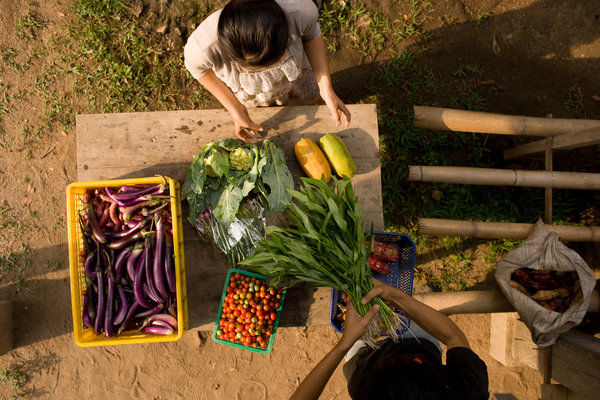
csa in mae tha, chiang mai! (not my photograph)
life is looking up. it's like this when i know i am about to travel. haven't gone to any field visits since late january. since then my camera has been stuck at the 16th marker and those 16 photographs remain a mystery unless i can add 8 more. despite the lottery of having a hidden gem written on film and as long as it remains undeveloped (black, dark), it leaves one feeling very unproductive (and sad).
traveling is more than seeing. a lot of reading (in thai), trying to learn about the history of the places i am going to. went to auntie's this weekend and she helped me get through my material quicker by reading it out loud and going through unfamiliar vocabulary with me. it's the first time she has really seen the work i've been doing. she thinks the vocabulary is bullshit and i love that she feels this way. it's good to know how the academics articulate these ideas, stories, histories, hopes, but it's equally as important to explain it in a way where anyone can take the true meaning home. great ideas have never relied on technical or difficult words. (i feel resistant to using big thai words, definitely not resistant to learning them, but i'd rather not create a habit of relying on this diction. it creates an unnecessary distance between you and people)
simplicity has been my mantra for the last few weeks. strategy is another word i am coming to love. i have a better sense for what it means and i am also not afraid of making plans while acknowledging risks. by that i mean i kind of enjoy planning for risks and i'm trying to use this tactic to be more prepared.
lately, always feeling like that there is a great deal to learn. taxing and sometimes stressful because at times it seems like my aim is to collect a lot, but we all know that it's not about the destination. it's about being docile to learning, docile to being taught and to understanding.
Monday, January 30, 2012
the human mind is as naturally sensitive to questions as the eye is to colors. the eye will not see if it is not kept open, and the mind will not follow a question if it is not awake. how to keep the mind open, how to keep wonder in your life; because wonder is the beginning of wisdom in learning (from nature, from books, from etc.)
just finished watching what remains, the sally mann documentary. i've written about it here before, like i said, there are things that you always return to, keep close to you. she has an unbelievable stamina, perseverance, great mind - i have a deep, deep, deep respect for her work and her practice, of both art and life.
such joy this weekend. letting my mind work. tink, tink, and then think. ineffable appreciation for language, for books, for poetry, for thought. they're teachers, dead, but amazing teachers.
my two questions for the rest of 2012:
what are the most basic and indispensable elements for developing your mind?
what are the most basic and indispensable elements for understanding communities?
just finished watching what remains, the sally mann documentary. i've written about it here before, like i said, there are things that you always return to, keep close to you. she has an unbelievable stamina, perseverance, great mind - i have a deep, deep, deep respect for her work and her practice, of both art and life.
such joy this weekend. letting my mind work. tink, tink, and then think. ineffable appreciation for language, for books, for poetry, for thought. they're teachers, dead, but amazing teachers.
my two questions for the rest of 2012:
what are the most basic and indispensable elements for developing your mind?
what are the most basic and indispensable elements for understanding communities?
Saturday, January 28, 2012
Related to my previous entry on the time spent on projects and fulbright, I'd like to make note on one of the few photographers I feel an affinity with. It's exciting for me to come across a recent article on Erika Larsen via New York Times that gives important insight on the process of such projects.
5 months is nothing here.
Alejandro Chaskielburg is another great one who still uses film and uses the most of moonlight.
5 months is nothing here.
Alejandro Chaskielburg is another great one who still uses film and uses the most of moonlight.
Friday, January 27, 2012
saturday morning reflections


there are just things in the world that you keep returning to. if you feel lost, in the all of the multitude of ways that is possible, there are things that keep you grounded, certain things that you remember or keep close as way to navigate back to yourself. time and time again, this (b)log and what it contains proves to serve that purpose for me. writing in general is a relief, but only because it helps solidify the process of experience - it's so important to know what you are thinking - it can skirt by so easily, for me at least, that writing is an effective way of staying aware. lately, i've been so caught up in the workings of the ngo office that i've forgotten about my personal tenor. it never disappeared, but i forgot to listen.
the service, the role of this ngo is important. i believe in and with what they are doing. however, i often forget that amongst the rest of my coworkers, i am a different breed. i wasn't trained to be a marketer, a scientist, sociologist or forester or a lawyer. the skills that i have developed (among others) is based in visual thinking or visual communication with a particular stress in poetry, by which i mean using language for it's broadest spectrum of meanings. it's a different kind of observation, that presents different kinds of questions and resolves problems that you present from your observations differently. in one sense, working with these other professionals, i am bettering those other skills/habits required to be a scientist, forester, writer, or sociologist (actually, a few of them, like the latter, i am inspired by), but i remain a visual thinker. by no means am i the best, or a very strong visual thinker, but this is what i am passionate about and this is what i have been practicing since the age of 17. "... the artist or craftsman in any field differs thus from those who lack his skill. He has a habit they lack. (Mortimer Adler)" Above everything else, visual thinking is my habit.
there are many different titles and backgrounds at work, and with the lack of synergy at the office, this means that people don't really understand where you come from, actually, where anyone is coming from. i have a similar experience outside of work which is another way of saying that i miss my community of friends who i can share my experiences and interests with. some of my friends here think that my favorite movies are too slow or that the music i like is really vintage. actually, i think their responses are both cute and fair, but it means you can never have a serious conversation or a dissection of that work because they don't share an interest in that same discourse. however, we do share an interest in the discourse of community forestry but we use a different ways of thinking and mine is not necessarily equally valued because it does not address the problem or issues in a way that is effective in their field or even their language. that leaves me sometimes feeling insecure about what i have to offer and i also end up asking myself whether i can make my work more effective in a language that is closer to theirs.
more importantly, rather than adjusting my language to theirs, i am also asking myself, what do i need to do to make this project great? if i want to share the collective knowledge of community forestry expressed by the communities, and if all human knowledge is acquired from experience, how do i create a secondary or third experience for which others can understand the primary experience? the thing is that scientists and foresters are responsible for information, not necessarily responsible for making it accesible or understandable. but as an artist, i feel that my role is to create an interruption for understanding: to provide viewers with an opportunity to leaven their knowledge rather than just adding forgettable information to their lives. i may not be contributing to the expansion of community forestry or increasing a community's livelihoods, but can i help people understand these communities, some of the poorest and most reliant on natural resources, are making an empowering and powerful choice in practicing sustainable natural resource management?

a quick scan of a family taking home a seedling after the eastern provinces of thailand community forestry network fair in the district of bong tong and province of chonburi, *note: in established community forests, one of the biggest challenges these villages face is engaging their younger generations in learning about natural resource management to continue maintaing the community forest.
Thursday, January 19, 2012
It's hard to not feel like there's something standing in the way - that maybe you haven't been honest to yourself about what you can do to be better. I think I need to start looking at my work more. Is it too measurable of a task for me to ask myself what this work needs to make it what I want it to be? I started doing that last night. I never liked photographing people before, it seemed extraneous, unnecessary. But in this project, people are necessary and I need to have more courage to photograph them. The project is asking for intimacy and intricacy to complicate this incredibly magnificent cultural history. It's becoming a much more narrative story than what I'm use to, but that is okay because sometimes different is good. This is the first project that I've attempted that comes from an established idea. It's like trying to write a great book- I'm trying to provide proof, or rather a beautiful argument that the world really looks this way or is this way. It does because I believe it to be so, so then the only thing that stands in my way is in my own skill in expressing this. I've barely skimmed the thought, by which I mean I've encountered this question without actually believing or thinking hard about it, but how many more projects, how many more years of my life will it take me to build these skills? This is a really difficult question to face because cowardice always comes out. If you're honest with yourself, the answer could be that you may never possess what it takes, but that is also the kind of answer that projects its own future. If you believe this answer, you will never possess that future, that dream is already an embarrassing memory.
I think I will go through many more projects. The number doesn't matter. The effort is more profitable than the product. I suppose it also depends on my hunger and my drive to satisfy my curiosity. I think there is probably a way to be strategic about all of this, although maybe we should call it Lyfe Strategy because there is always an unknown, but great algorithm for how life unfolds.
Well, I didn't pass the first selection of Fulbright candidates, which means no Fulbright at all. Goddamn, I put so much work into that application but it basically means that I am so glad I never waited around to hear from them and that it was the right thing to do to move Thailand when I did. Plan B worked.
I think I will go through many more projects. The number doesn't matter. The effort is more profitable than the product. I suppose it also depends on my hunger and my drive to satisfy my curiosity. I think there is probably a way to be strategic about all of this, although maybe we should call it Lyfe Strategy because there is always an unknown, but great algorithm for how life unfolds.
Well, I didn't pass the first selection of Fulbright candidates, which means no Fulbright at all. Goddamn, I put so much work into that application but it basically means that I am so glad I never waited around to hear from them and that it was the right thing to do to move Thailand when I did. Plan B worked.
Wednesday, January 18, 2012
I've put down i six nonlectures to read Mortimer Adler's How to Read a Book. While i'm not looking to be too well read, I would rather have read a few books well. So if given only a few choices, this book would be near the top of my list. It is an essential reference for being a stronger learner and a more receptive and active thinker.
What I've been gleaning is absolutely invaluable such as learning how to understand the difference between increasing your information and increasing your understanding. They are far from the same, although competitively equal in value. For example, while you can gain information through the acquisition of facts, it does not mean that you are understanding more. In fact your understanding remains the same, unleavened, if you do not learn the facts and their significance. Reading, as Adler defines, is "the process whereby a mind, with nothing to operate on but the symbols of the readable matter, and with no help from outside, elevates itself by the power of its own operations. The mind passes from understanding less to understanding more. The operations which cause this to happen are the various acts which constitute the art of reading." So to come to an understanding is an active effort that is in actuality a very powerful and empowering culmination of oneself.
In coining what makes a good book, Ernest Hemingway also touches on the experience of understanding the written word, "All good books are alike in that they are truer than if they had really happened and after you are finished reading one you will feel that all that happened to you and afterwards it all belongs to you: the good and the bad, the ecstasy, the remorse and sorrow, the people and the places and how the weather was. If you can get so that you can give that to people, then you are a writer."
Basically, I can't put this book down. This experience of understanding is clearly not limited to reading. I feel so lucky to have know the gift of art, to have felt like I was a receiver at a few points in my life.
What I've been gleaning is absolutely invaluable such as learning how to understand the difference between increasing your information and increasing your understanding. They are far from the same, although competitively equal in value. For example, while you can gain information through the acquisition of facts, it does not mean that you are understanding more. In fact your understanding remains the same, unleavened, if you do not learn the facts and their significance. Reading, as Adler defines, is "the process whereby a mind, with nothing to operate on but the symbols of the readable matter, and with no help from outside, elevates itself by the power of its own operations. The mind passes from understanding less to understanding more. The operations which cause this to happen are the various acts which constitute the art of reading." So to come to an understanding is an active effort that is in actuality a very powerful and empowering culmination of oneself.
In coining what makes a good book, Ernest Hemingway also touches on the experience of understanding the written word, "All good books are alike in that they are truer than if they had really happened and after you are finished reading one you will feel that all that happened to you and afterwards it all belongs to you: the good and the bad, the ecstasy, the remorse and sorrow, the people and the places and how the weather was. If you can get so that you can give that to people, then you are a writer."
Basically, I can't put this book down. This experience of understanding is clearly not limited to reading. I feel so lucky to have know the gift of art, to have felt like I was a receiver at a few points in my life.
Monday, January 9, 2012
my house is real, just not measurable
numbers have a place. numbers are important when you have people to report to. also some people see better by numbers. and some people or groups like things they can grab on to and so they know what to do next. it's quite helpful if you're in charge of many people.
when i stand next to this idea, i feel very short or very tall. i don't see eye to eye with her because it is the immeasurable that inspires me. it's not about the number of times --- that happens, it's that it's happening! it's really happening and it's going to be different every time it happens and you just have to be there!
for instance my most recent guest asked me a lot of measurable questions i didn't know and a little later i realized that i have very little interest in this kind of knowledge.
"how many people live in bangkok?"
"i don't know"
it turns out 12 million. i don't think about the bangkok as 12 million people. i think about how it smells like diesel, coffee, and jackfruit on very hot and crowded days. and if you turn on specific corners it also smells like jasmine and deep fried pork. and all of this will change with the fluctuation of people and what they order for lunch. in that case, numbers are have a say in what this city smells like, but is it numbers or something more impalpable that is a source for this decision? for a second though, I wondered if i should could consider knowing more measurable information. surely it wouldn't hurt to know more measurable knowledge, but somehow my memory is not inclined to holding that kind of information.
measuring feels especially horrible in situations where there is no need to measure. for instance, when you stand yourself next to someone else and you make yourself see all the irrelevant contrasts- all the things that make you feel bad, unless you are egotistical and in that case, all the reasons that make you feel good. it still doesn't matter.
my eyes crossed this text many weeks ago. although i have read the first part of the text years and years ago, when i read the latter half i knew i had believed in this my entire life:
…so far as I am concerned, poetry and every other art was and is and forever will be strictly and distinctly a question of individuality…poetry is being, not doing. If you wish to follow, even at a distance, the poet’s calling (and here, as always, I speak from my own totally biased and entirely personal point of view) you’ve got to come out of the measurable doing universe into the immeasurable house of being…Nobody else can be alive for you; nor can you be alive for anybody else. Toms can be Dicks and Dicks can be Harrys, but none of them can ever be you. There’s the artist’s responsibility; and the most awful responsibility on earth. If you can take it, take it–and be. If you can’t, cheer up and go about other people’s business; and do (or undo) till you drop.
when i stand next to this idea, i feel very short or very tall. i don't see eye to eye with her because it is the immeasurable that inspires me. it's not about the number of times --- that happens, it's that it's happening! it's really happening and it's going to be different every time it happens and you just have to be there!
for instance my most recent guest asked me a lot of measurable questions i didn't know and a little later i realized that i have very little interest in this kind of knowledge.
"how many people live in bangkok?"
"i don't know"
it turns out 12 million. i don't think about the bangkok as 12 million people. i think about how it smells like diesel, coffee, and jackfruit on very hot and crowded days. and if you turn on specific corners it also smells like jasmine and deep fried pork. and all of this will change with the fluctuation of people and what they order for lunch. in that case, numbers are have a say in what this city smells like, but is it numbers or something more impalpable that is a source for this decision? for a second though, I wondered if i should could consider knowing more measurable information. surely it wouldn't hurt to know more measurable knowledge, but somehow my memory is not inclined to holding that kind of information.
measuring feels especially horrible in situations where there is no need to measure. for instance, when you stand yourself next to someone else and you make yourself see all the irrelevant contrasts- all the things that make you feel bad, unless you are egotistical and in that case, all the reasons that make you feel good. it still doesn't matter.
my eyes crossed this text many weeks ago. although i have read the first part of the text years and years ago, when i read the latter half i knew i had believed in this my entire life:
…so far as I am concerned, poetry and every other art was and is and forever will be strictly and distinctly a question of individuality…poetry is being, not doing. If you wish to follow, even at a distance, the poet’s calling (and here, as always, I speak from my own totally biased and entirely personal point of view) you’ve got to come out of the measurable doing universe into the immeasurable house of being…Nobody else can be alive for you; nor can you be alive for anybody else. Toms can be Dicks and Dicks can be Harrys, but none of them can ever be you. There’s the artist’s responsibility; and the most awful responsibility on earth. If you can take it, take it–and be. If you can’t, cheer up and go about other people’s business; and do (or undo) till you drop.
Thursday, January 5, 2012
i'm crazy about this
toasted coconut flakes
toasted peanuts
dried shrimps
diced ginger
diced lime with peel
shallots
tamarind sweet sauce
in
fresh grape leaves
toasted peanuts
dried shrimps
diced ginger
diced lime with peel
shallots
tamarind sweet sauce
in
fresh grape leaves
Subscribe to:
Posts (Atom)